Certification preparation
Business Analysis for Cybersecurity (IIBA-CCA) Study Support in Mumbai
Showing starts assigned to Mumbai. Change country or city · Global course
A 3-day course where you analyse security needs, shape risk-driven requirements, assess solutions, and practise exam-style tasks in teams.
THE BIG PICTURE
About this course
The Certificate in Cybersecurity Analysis (IIBA-CCA) recognises business analysis skills applied to cybersecurity change and operations. It is awarded by the International Institute of Business Analysis (IIBA). Across three days (09:00 to 17:30), you explore security needs, stakeholder analysis, risk-driven requirements, control options, process and solution assessment, and communicating assurance and business impact. You will work through realistic scenarios, produce analysis artefacts, discuss decisions, and receive feedback, with daily exam-style practice. The certificate is earned by passing a computer-based knowledge exam purchased from IIBA. No project portfolio, interview, or verified work experience is required to register. You schedule the exam through IIBA’s exam provider. International Institute of Business Analysis (IIBA) owns the certification scheme. MindClick provides training and exam preparation and is not an accredited or authorised partner.
What you’ll learn
- Identify and engage security stakeholders across business and technology roles
- Elicit and document security needs using scenarios, assets, threats, and misuse/abuse cases
- Formulate risk statements and prioritised, testable security requirements
- Select and justify control options and trace them to risk, policy, and regulatory drivers
- Assess business processes and solution designs for security gaps and residual risk, with evidence
- Communicate assurance findings, metrics, and business impact to decision-makers
- Use structured exam techniques, complete practice questions and a timed mock, and plan next steps for sitting the exam
A CLEAR PATH FORWARD
3-day course agenda
3 instructor-led days (24 contact hours) mapped to the exam domains. Each day combines short concept sessions, hands-on practice on a running case study and exam-style questions.
- Learning route
- 3 recommended days
- Practical work
- 3 guided activities
- Finish with
- Mock exam + certification exam
Take a look at each day. Open a section to see the topics and practical work.
Day 1Security needs and stakeholder analysisSecurity needs and stakeholder analysis; risk requirements
What we’ll cover
- 09:00–10:30 · Course goals and the cybersecurity analysis context
- 10:45–12:15 · Stakeholder analysis for security change and operations
- 13:15–14:45 · Eliciting security needs: assets, threats, and misuse/abuse cases
- 15:00–16:00 · Framing risk: likelihood, impact, and precise risk statements
- 16:00–16:30 · Prioritising risk-driven requirements and acceptance criteria
- 16:30–17:00 · Exam-style practice questions: needs, stakeholders, and risk
- 17:00–17:30 · Daily reflection and Q&A
Put it into practice
Work in pairs to map a high-level business service, identify assets, and build a stakeholder map with roles and concerns. Draft initial risk statements and a first cut of security requirements linked to those risks.
You’ll take away
Stakeholder map and initial security requirements backlog
Day 2Risk requirements and control options; process and solution assessmentControl options; security-related process and solution assessment
What we’ll cover
- 09:00–09:30 · Recap of Day 1 and plan for Day 2
- 09:30–10:30 · Control types and selection: preventive, detective, corrective, and compensating
- 10:45–12:15 · Security architecture viewpoints and access management fundamentals
- 13:15–14:45 · Process analysis for security: data flows, trust boundaries, and threat modelling
- 15:00–16:00 · Solution assessment: security testing approaches and evidence collection
- 16:00–16:30 · Communicating design trade-offs, assumptions, and residual risk
- 16:30–17:30 · Exam-style practice questions and review
Put it into practice
Analyse a target process, propose a minimum control set aligned to identified risks, and justify selections against business constraints. Evaluate a sample design for residual risk and document testing evidence needed.
You’ll take away
Process security assessment with proposed control catalogue
Day 3Communicating assurance and business impact; exam preparationCommunicating assurance and business impact; full exam practice
What we’ll cover
- 09:00–09:20 · Recap of Day 2 and objectives for Day 3
- 09:20–10:30 · Assurance reporting, metrics, and stakeholder communication
- 10:45–12:15 · Business impact analysis, risk acceptance, and sign-off pathways
- 13:15–14:15 · Incident response, continuity, and lessons-learned feedback loops
- 14:15–15:00 · Integrating security into BA artefacts and change governance
- 15:00–16:00 · Mock exam (timed, exam-style questions)
- 16:00–16:30 · Mock exam debrief, personal action plan, and exam booking guidance
- 16:30–17:30 · Open clinic: question bank walk-through and final Q&A
Put it into practice
Create an executive-friendly assurance summary for a case study, including metrics and recommended decisions. Complete a timed mock exam and use results to refine a personal study and booking plan.
You’ll take away
Draft assurance report and personal exam study plan
Bring it all together
Certification exam: Certificate in Cybersecurity Analysis (IIBA-CCA), awarded by International Institute of Business Analysis (IIBA). Confirm the current exam format with the awarding body when you book. Every attendee also receives a MindClick certificate of completion for 24 contact hours.
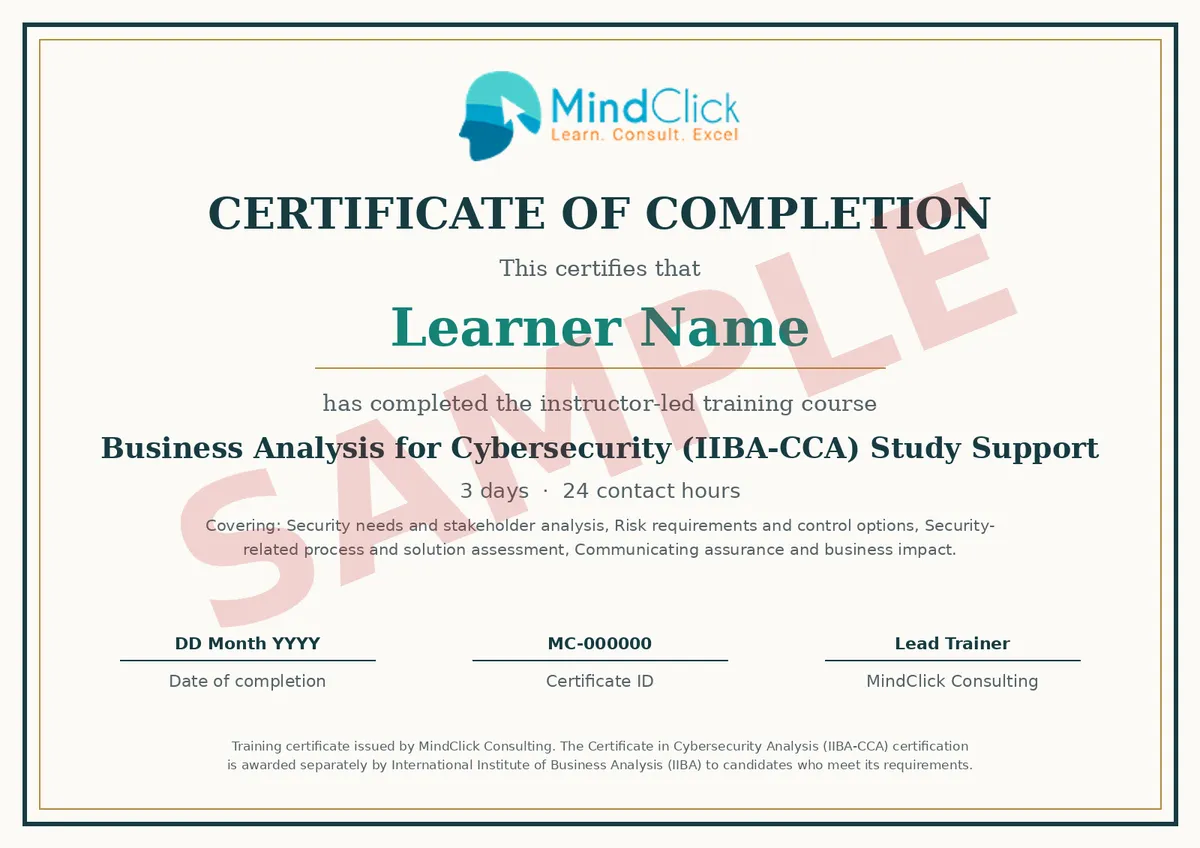
What you receive
You earn two separate credentials. The sample shows the MindClick training certificate.
- MindClick certificate of completion: 3 days, 24 contact hours, issued to every attendee who completes the course.
- Certificate in Cybersecurity Analysis (IIBA-CCA): issued by International Institute of Business Analysis (IIBA) when you meet its requirements and pass the exam.
Before you choose your learning route
Session timings are indicative; the trainer may adjust them for the group. Exam details reflect the awarding body’s published information at the time of writing; confirm the current version when you book.
International Institute of Business Analysis (IIBA) owns this certification scheme. MindClick provides training and exam preparation and is not an accredited or authorised partner of International Institute of Business Analysis (IIBA).
Fees
| Delivery format | Fee per learner | Exam fee |
|---|---|---|
| Live online | $410 USD ≈ ₹39,500 |
Not included |
| Classroom | $770 USD ≈ ₹74,200 |
Not included |
Local amounts are indicative only, converted at the rate captured on 2026-10-02. You are charged in USD and your bank sets the final rate.
Awarding-body exam and certification fees are not included in the training fee. Confirm the current fee, any applicable tax and what the fee covers in writing before you pay.
For training in India, fees are confirmed by an advisor and card payment is not available online yet.
Prerequisites
- No formal prerequisites are required by IIBA for the CCA exam. Recommended: some familiarity with business analysis and basic information security concepts; bring a laptop with spreadsheet and diagramming tools.
FIND YOUR START
Confirmed batch starts
Choose a published start, then review your offer in the same enrollment flow. A start date is not the full timetable or a seat reservation.
Choose your country & monthStarts
- Training location
- Mumbai, India
- Local timezone
- Asia/Kolkata
Venue and full session timetable to be supplied.
Starts
- Training location
- Mumbai, India
- Local timezone
- Asia/Kolkata
Venue and full session timetable to be supplied.
Starts
- Training location
- Mumbai, India
- Local timezone
- Asia/Kolkata
Joining details and full session timetable to be supplied.
Starts
- Training location
- Mumbai, India
- Local timezone
- Asia/Kolkata
Joining details and full session timetable to be supplied.
Starts
- Training location
- Mumbai, India
- Local timezone
- Asia/Kolkata
Venue and full session timetable to be supplied.
Starts
- Training location
- Mumbai, India
- Local timezone
- Asia/Kolkata
Venue and full session timetable to be supplied.
Frequently asked questions
How long is the course?
3 days, 24 contact hours, normally 09:00 to 17:30 with breaks. The agenda follows the exam domains and the final day includes a mock exam.
Is the exam included?
Yes. Outside India the fee includes one certification exam attempt. Retakes are booked and paid directly with the awarding body.
Are there prerequisites?
No formal prerequisites are required by IIBA for the CCA exam. Recommended: some familiarity with business analysis and basic information security concepts; bring a laptop with spreadsheet and diagramming tools.
What certificate will I receive?
Two credentials. MindClick issues a certificate of completion for 24 contact hours to every attendee. International Institute of Business Analysis (IIBA) issues the Certificate in Cybersecurity Analysis (IIBA-CCA) certification when you pass the exam and meet its requirements.
Is MindClick an accredited training partner for this certification?
MindClick provides training and exam preparation and is not an accredited/authorised partner of IIBA. The Certificate in Cybersecurity Analysis (CCA) exam is administered by IIBA via its exam provider.
KEEP EXPLORING
More ways to move forward.
Related training from the course catalog.


CBAP - Certified Business Analysis Professional
Five-day (35-hour) course to practise BABOK v3 across all knowledge areas through cases and drills, preparing for the IIBA CBAP exam.
CCBA - Certification of Capability in Business Analysis
Three-day CCBA prep covering BABOK v3 knowledge areas; learners apply techniques in a case study and drill exam-style questions each day.
Business Process Management
Three-day, 24-hour course on BPM practice: model processes with BPMN, analyse and improve workflows, and plan automation and governance.
Requirements Engineering
Three days (09:00–16:30) of hands-on practice to elicit, document, validate and manage requirements using scenarios, models and reviews.